Q. “My son seems like he’s in the midst of a contest every moment. He needs to be first to get to the car, first to choose his seat, first to finish his dinner. He also needs to be best. Because he has a younger sister, this is a very irritating fixation, because he’s always showing her how he’s better than she is, which of course he is, being two years older than she! She and he have a difficult relationship because of his need to be first and best! What can I do to help him not be one of those super-competitive children and just live his life, rather than try to prove over and over again how good he is? Oh, and by the way, losing is a big issue for him, too, in games or anything else.”
 There’s not a quick fix for your son’s fixation on being first and best. If there were, we would have a much more peaceful world. This “need to be best” is actually endemic in our society. How many times have you been asked to agree with the sentiment that our country is the best country in the world?
We are trained to be competitive from early in our lives. Some of us can see that there are many attributes that each person, each city, and each country has that can be appreciated, and that there’s always going to be something a person, city or country can learn from another. But many of us have grown to need to be on the “winning” side of every issue, in order to feel OK.
The strong need to win often has roots in an early hard time

Often, the root of a child’s competitive behavior that shows up time and time again is some early difficult time in their life. Something like a hospitalization, a severe illness, a separation from a parent, or some other grinding tension at home can leave a child feeling helpless and alone. That feeling sticks with a child. It is kept under wraps in the child’s emotional memory, but the effect of it shows up in how they interact with others.
With that early emotional ache still held fast inside him, a child sets out to try hard to make themselves feel better. When they feels like they are in control—they are first, or best, or the boss—the ache doesn’t seem so bad. They carry the emotional memory of desperately needing attention, the attention they couldn’t feel when they were ill, threatened, or when their family was under stress. So, under the guise of proving themselves every 15 minutes, a child will make repeated bids for the attention they didn’t get, way back then. There’s no crisis now, but the feeling of needing attention immediately is insatiable. No matter how much attention a child gets for being first or best or the boss, it never feels like enough. They need more, ever more!
Super-competitive children will signal often for your help
Super-competitive children need attention, but not in the way they are seeking it. They need their parents to come close, to show them affection, to show their love. But they don’t need to win all the time! And they don’t need to be first, or the boss, all the time.
What they do need is a chance to offload the emotional hurt that’s left over from early helpless times, so that they can feel closer to those around them, and more open to the give and take of life. A parent is in the very best position to relieve the sting of early hard times that’s at the root of super-competitive behavior. You don’t really need to know what makes your child so competitive—you might have a guess, but no analysis of the root of the problem is necessary. What is helpful is the use of two very powerful Listening Tools: Playlistening and Staylistening.
These Tools help your child laugh (not forced by tickling, but encouraged by nuzzling, wrestling, and affection) and cry great big hearty cries, with your support. These emotional release valves let the tension out, and let your child feel your caring. They help heal the hurt, as long as you are there to pour in your love and your confidence that your child’s life is good. Here’s how to proceed.
Playlisten to reassure your child that they are loved, and to invite laughter.
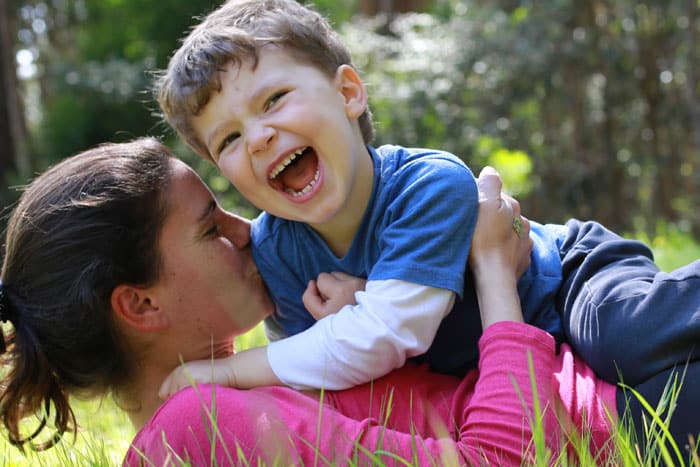 Playlistening is playing to evoke laughter, but without forcing it—in other words, no tickling allowed. With a super competitive child, two kinds of Playlistening are helpful. In one, you lose again and again, and allow them to win. You playfully keep trying. You playfully never give up hope. But your child is the victor. You watch for what makes your child laugh, and you keep doing that, and variations on that theme.
For instance, I was once playing basketball with a little boy, just three years old, who was already a super-competitor. We played on a little plastic basket, and several other adults were around to cheer us on. He and I would take turns trying to make baskets. I would almost always miss, and he would almost always make a basket. He would laugh hard every time we announced the score—Eric, 10, Patty, Goose-egg!
Soon, the spectators took on the role of score announcers, with great relish, so I could be alternately totally deflated, sometimes falling on the floor in outlandish defeat, and then springing up, hopeful again that I might win, or at least get one basket. He laughed hard all the way through that game! At the end, he was so proud that his score was 100, and mine was a poor, measly, terrible, lowly, embarrassing 8! I continued to play the loser to the hilt, and he laughed and felt wonderful.
The older and more capable a child is, the more of a contest you have to set up with them, but don’t try to be skilled at a sport. Set up contests that let you show affection. “I’ve got 100 kisses for you” is a good one, where you chase them and catch them and try to land a kiss, and your child gets away scot free often, but not all of the time. You keep trying. “Come on, feel the love!” is what I tell my grandson when we’re playing this kind of affection game. You can complain that your kisses need a place to land, a lovely place to land.
Or, when your child arrives first at the kitchen table at lunch on Saturday, and announces it to make his sister feel badly, just say, “OK, I get to hug the guy who got here first! Yes, I do!” and chase him all through the house, giving him a good contest. Matter of fact, you can do that for many of the “wins” he announces.
You can vary your affectionate response. “OK, the prize for First is a noogie on the head. Come here, you handsome Champ, you!” or “Yay, you came in first at the car door! The one who comes first gets to be lifted into the car upside down! And the one who comes in second gets lifted into the car right side up!” Or, “Hey, look who’s first again. You know what I do with the one who’s first? They get a great big snuggle from me!” followed by a really big squeeze. You give an affectionate squeeze to the child who’s second, too.
This kind of response will get laughter going around being first, and will help you bring your super-competitor your affection and energy many times a day, warming up your relationship with them, and beginning to fill that aching need for reassurance that lies underneath their drive to be first. As laughter rolls, they are receiving your attention and affection. It reaches their emotional center. It helps heal the hurt.
When several children are playing together, and your super-competitor is loudly announcing that they are first again and again, join the game. Come in last, and let the children all laugh at your last-place finish. “Hey, Joey is first! Helen is second! Ray-Ray is third, and, oh no, not again! I’m last??!! Yikes, last again!” will help them play together without feeling less than.
When your child loses, or when you set limits on bossiness – Staylisten.
As you get laughter going in your household, and pursue affectionate contests and playful responses to your child’s hunger for winning, their sense of emotional safety will build. You’ll notice that they become more explosive when little things disappoint them. This is a sign of progress! When they are upset, you have a golden opportunity to move close, and to pour in the love and reassurance they so badly needed earlier in their life.
The disappointment over a sandwich cut wrong, or a videogame they are not allowed to finish because it’s bedtime, will be enormous. And all that emotion is there, not because they’ve lost their mind, but because that was the size of the emotional hurt they sustained when they were much smaller, much more vulnerable, and deeply in need of someone to listen to them.
So, listen. Stay close. Don’t give in on a sensible limit you have set. “I know it’s hard to let your sister have her turn at that game. She doesn’t do it the way you would,” is what you say while your child fights and kicks to get away from you, wanting to run and grab the game away.. You stay. You keep her safe from their intrusion. They cry and fight, safe but very unhappy, in your arms, while you say now and then, “I know you don’t want her to touch it. But it’s her turn, and you’ll get another turn in awhile.”
Allow them to feel desperate. To feel like their world is so unfair. To feel like nothing is right. To feel like everything is ruined for them. These are feelings erupting from the past, splashing onto the present in a big, messy way. This is what heals the hurt that makes it hard for them to accept others and to play with others, rather than against them.
As you stay with your upset child, they may become panicky. “I need to get out! Don’t hold me here! I need to breathe! I can’t breathe!” or “I’m burning up!” or “I’m thirsty, you have to get me some water! I need water now!” This panic is a key part of releasing fear. They need you to guide them through their panic, without trying to fix it. They may indeed be hot, but they are not going to die. They may indeed feel thirsty, but another few minutes without a drink will be OK. What they most needs is your confidence that they are going to make it, that their life will be good, and that you’re not going to leave them stranded.
Don’t get too busy trying to fix anything. Just lift their shirt and blow on their tummy if they are hot. Or offer to carry them in your arms to get water, if they are thirsty. Usually, a child who is panicked will refuse to let you carry them to get a drink. Being carried continues the closeness you provide, and it’s no escape from facing and feeling how frightened they once were. They know they don’t need a drink that badly. If they do, they’ll let you carry them there.
When you have listened enough, and their mind is finally free of the grip of stale-dated emotions, they’ll be glad to be close to you. They may cry some, but not while fighting you. They’ll lean in for support and love. And whatever the issue was that set them off will resolve in their mind, usually without rancor toward anyone. They’ll be able to let it go. And you will most likely see some changes in their behavior that signal that they’ve gained a little flexibility.
They showed you how bad it felt once. You received their feelings, listened, and stayed through the storm. Their need to prove themselves goes down a notch, though they may have to show you their feelings a number of times before they can become a truly less-than-super-competitive child.

A Listening Partner will help you listen and play well.
Things will progress even faster if you can create a Listening Partnership for yourself, so you can talk to a non-judgmental parent about your feelings about your super-competitor. You may feel like they are “bad,” or feel like they are ruining your family’s peace and serenity, or worry that they are never going to learn to play well with others. These feelings need to be heard by someone who will just let you have your say.
It will help to talk about your pregnancy and the birth of your child, and how things went during their first year or two. If you find things to be angry about or to cry about there, go ahead! Or if you’re tempted to yell at or lecture your super-competitor, a Listening Partner is the ideal person to do that with. Letting off your own emotional steam will make it easier to play affectionately so that laughter ensues, and to listen to your child when they feel the chips are down, so that they are ever surer of your love.
From the Hand in Hand Toolbox
How to find a Listening Partner
Find your online village within the FREE Hand in Hand Community.
Reduce overwhelm and stress as you deepen your connection to your children. Find Listening Partners and get daily coaching around your biggest parenting challenges. Learn to implement the Hand in Hand Tools with confidence for consistent results as you create more cooperation and peace in your home.