

When a child resist's sleep, he or she is not deliberately trying to manipulate or annoy.
Bedtime often involves a period of separation between a parent and a child that can be confronting for them. Darkness can be scary for some, but when the day slows down, it's also a time when uncertainties can resurface and cause kids alarm.
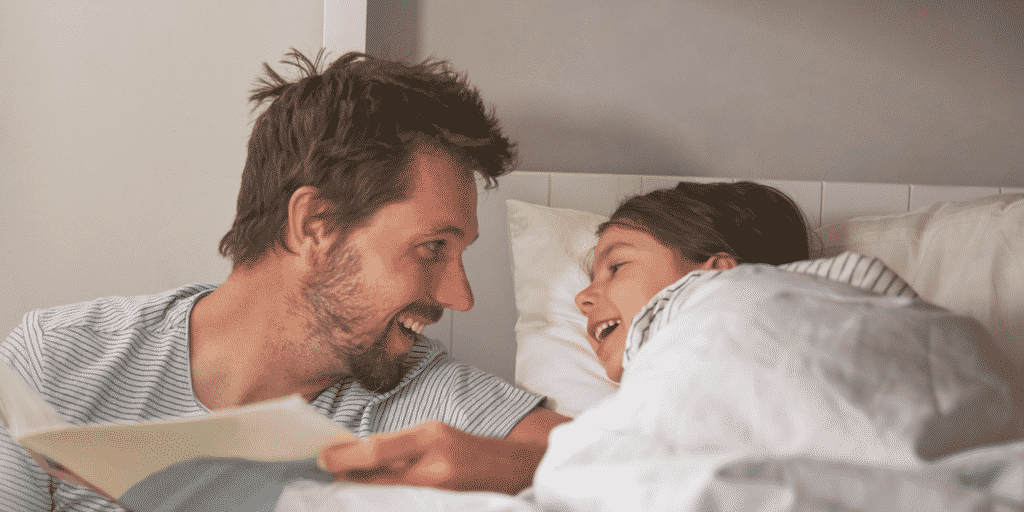
How Do I Know My Child Is Scared to Sleep?
Does this sound familiar?
“Ok, sweetie, we have finished our stories and now it's time for light's out.”
“But… I need one more class or water before I sleep.”
“Ok, have one more sip and then we are turning out the lights.”
“But I'm really thirsty. I need one more. Pleeeease?!!”
Sometimes children do come right out and tell you that they are scared, maybe of monsters or ghosts in the dark, but at other times look for these rigid behaviors to show you there is something stopping them from wanting to sleep. A child using these kinds of “stay awake,” tactics is showing you he is scared of something.
Left unchecked, these behaviors can become set in stone. A child might even begin adding more “conditions” before he agrees to sleep.
- 3 stories, 2 songs, a hug and a kiss
- 2 cups of water, a hug for me, a hug for teddy, lay with us for 5 minutes
Soon, you are playing song and dance to each request. Sleep becomes a real waiting game. We parents get trapped into believing if we can fulfil each request, bedtime will run smoothly.
But the real answer to more peaceful goodnights lies in healing the underlying fears that cause the behavior.
One Little Known Trick To More Peaceful Bedtimes
“When we think about bedtime, we need to think about letting children offload their tensions before they try and sleep,” says Hand in Hand Instructor Catherine Fischer.
Catherine joined fellow instructor Yasmeen Almahdy on this Facebook Live. Both instructors talked about calm and playful responses parents can use to address a child's sleep issues.
Adopting some tension-releasing techniques into a nightly routine, just as we would bathing or brushing teeth, can help bring about more peaceful bedtimes, and are easy to apply, she says.
 Make Time To Play!
She offered a surprise solution for addressing those fears, and something usually shied away from when we think about putting children to bed: Play.
“Play and connection are so important for helping children with their fears,” Catherine says. Although it's not often the first tool we think of when we think about a peaceful bedtime, laughter helps children release light tension and minor fears. Good play naturally arouses laughter, which is why it actually makes sense to play before bed.
Planning on Play before Bed:
- Try to include as much opportunity to laugh during the day, but especially as it is coming to an end. Jokes at dinner, general silliness, and rough-housing games all work to release stress.
- Start bedtime a little earlier to make time for added play, and avoid your own stress levels boiling over if you are concerned about a later bedtime.
- “For a long time, with our son, we would do pillow fighting before bed. Often he had stresses from school, fears that he'd collected during the day that had gone unresolved. Pillow fighting gave him a chance to laugh away that tension,” Catherine advises.
- Be a terrible playmate! The play that is best for kids is a play that lets them laugh most. Often this happens when they can excel in what you are playing, and you lose! “Be bad pillow fighters,” Catherine advises. “Usually it made our son laugh if we totally missed him. Other times we'd just lightly tap him. Try to do whatever makes him laugh the most!” she says.
- Start bedtime a little earlier. It's easy to feel stressed about kids needing a certain amount of sleep, as well as the fact that most of us are aching for some alone time at the end of a day, so begin a nightly routine earlier than usual to allow for play. A good 10-20 minutes a few nights a week can work wonders. “It only took us one or two nights of making sure we played before bed to see a difference,” Catherine says.
You can watch Catherine and Yasmeen's whole Facebook Live session here.
Sometimes play isn't enough to help children release. Read How to Set Limits That Help Children Sleep for more guidance.
Would you like to confidently help your child sleep through the night? Enrol on our Helping your Children Sleep class.
Like these ideas? Get 5 Revolutionary Ideas to Make your Parenting Less Stressful.